
Prefabrication & Circular Design
We aim to make buildings as future-proof as possible: adaptable, designed for disassembly, with a modular design that extends the building’s life span.

Integration of circular economy principles in key services
Circular design starts with a question we ask at the beginning of every project: what happens to this building at the end of its life?
By designing for disassembly, adaptability, and flexibility from the outset, we ensure that structural components can be recovered, reused, or repurposed rather than demolished and landfilled. This principle is embedded across the Cordeel Group and applied where it has the greatest impact, in our own production systems, our timber construction offer, and our development projects.
Prefabrication is one of the most direct ways to put circular design into practice.
When components are produced in a controlled factory environment rather than cast in place on site, we can design connections that allow disassembly, control material quantities with precision, reduce construction waste, and test new materials and structural systems before they reach the project. The factory setting also allows for continuous improvement: every production run is an opportunity to refine mixes and design, reduce material input, and push the performance of what we build with.
Our two most advanced prefabrication platforms are C-concrete’s C-fast system, a precast concrete system designed specifically for disassembly and modular assembly, and Sinqer, our circular prefab timber construction system launched in 2025, built around bio-based materials and designed for reuse from the first drawing.
C-metal fabricates steel structures in the production facility in Temse, working with efficient machines like a CNC punch-cutting line and even a plasma cutting robot.

CSRD:
C-fast precast system: designed for disassembly
C-fast is our patented and innovative building system in precast concrete, with smart couplings for columns and prestressed floor slabs that are produced by C-concrete.
The major advantages of this system compared to the traditional methods are a much faster construction time and assembly (less than one week per floor), lower construction costs, and a modular design that allows for later adaptations and disassembly.
Not including fixed interior walls will allow for easier adaptations and repurposing of our buildings in the future, as the built-in flexibility can give a second or third life to buildings, without major demolitions.
C-fast is best suited for buildings with repetitive character like high-rise residential buildings, mixed-use or student housing.
The prestressed floors include the techniques and are smoothly finished with self-leveling concrete. Therefore no screed is necessary and the necessary additional material and drying time is avoided.
Producing prestressed elements demands for fast drying times and is mostly compensated by using solely CEM I cement which leads to elevated embodied carbon.
Currently, 25% of the cement used for the production of these elements at C-concrete is CEM III/A. In the future, we’re looking into reducing the embodied carbon of the C-fast system even more.
CSRD:
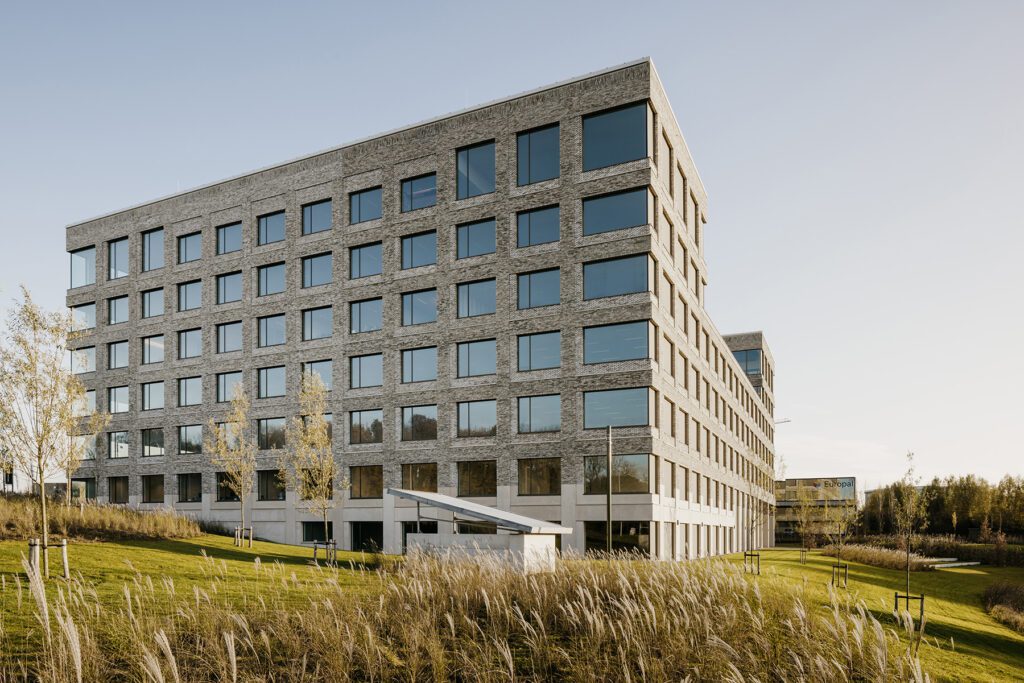
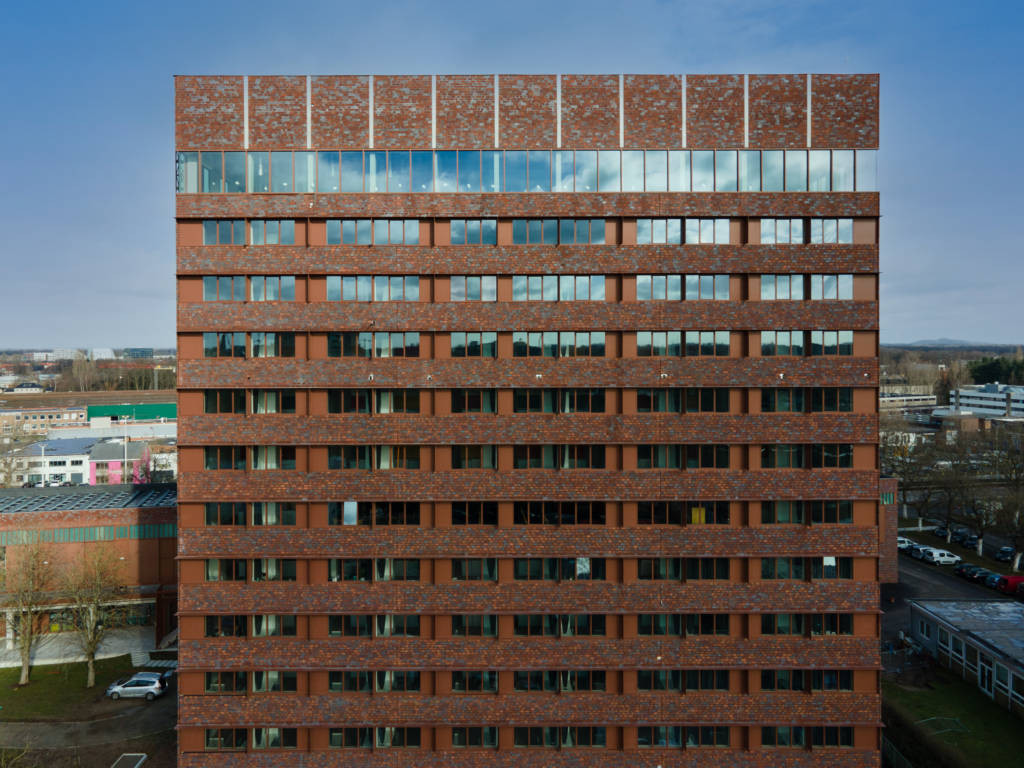
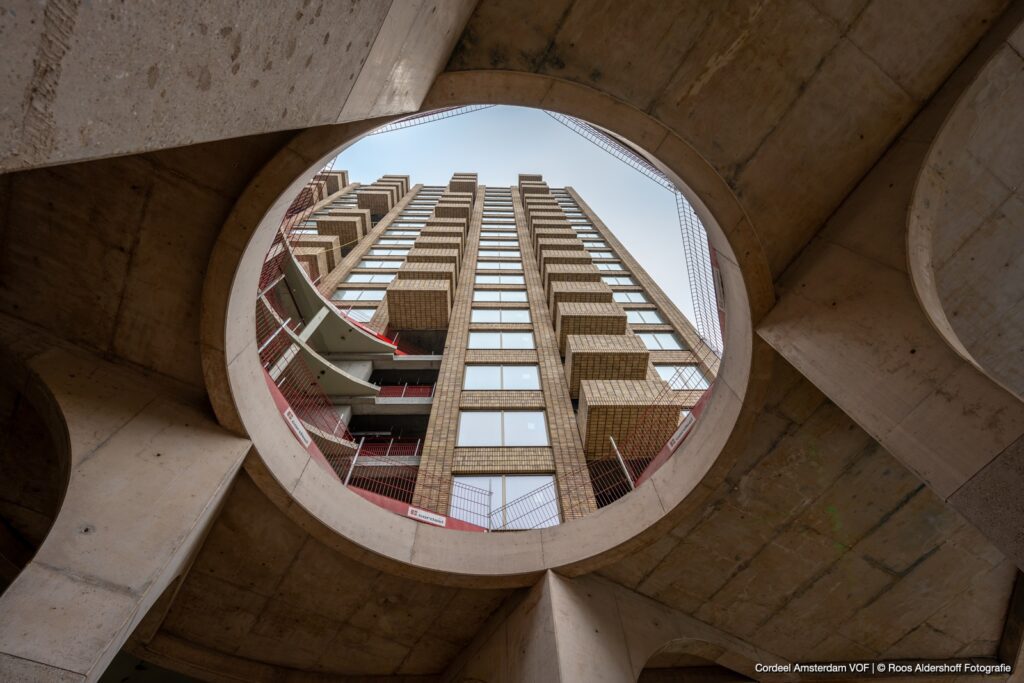
Impressions C-fast
Xior Totem (Hasselt), Kortrijk Businesspark, The Ensemble (Amsterdam)
Sinqer – 3D prefabricated timber modules
Sinqer is Cordeel Group’s circular prefab timber construction system, launched in late 2025.
It is built around 3D prefabricated modules, largely bio-based, that are assembled within the group’s own production facilities before being installed on site. T
he materials store CO₂ and the construction time on site is significantly shorter than conventional methods.
The system integrates engineering, prefabrication, and installation into a single coordinated chain, giving clients a faster and lower-carbon alternative to traditional construction without compromising on quality or design freedom.
Sinqer is being positioned with architects, developers, and investors as Cordeel’s answer to the growing demand for circular, low-carbon construction at scale.
CSRD:
Circular facades for industrial buildings
With insulation not being glued in sandwich panels, but tucked in coffer facades, the insulation and the facade finishing can be disassembled and adapted if needed. This approach will increase the value and adaptability of our buildings in the long run.
Where possible, we strive to use glass wool for insulation in our projects due to the smaller environmental impact than PIR insulation. We’re currently investigating the use of bio-based insulation materials, as we think this might be a solution to lower the embodied carbon of buildings even more.

CSRD:
Building passports to demonstrate circularity
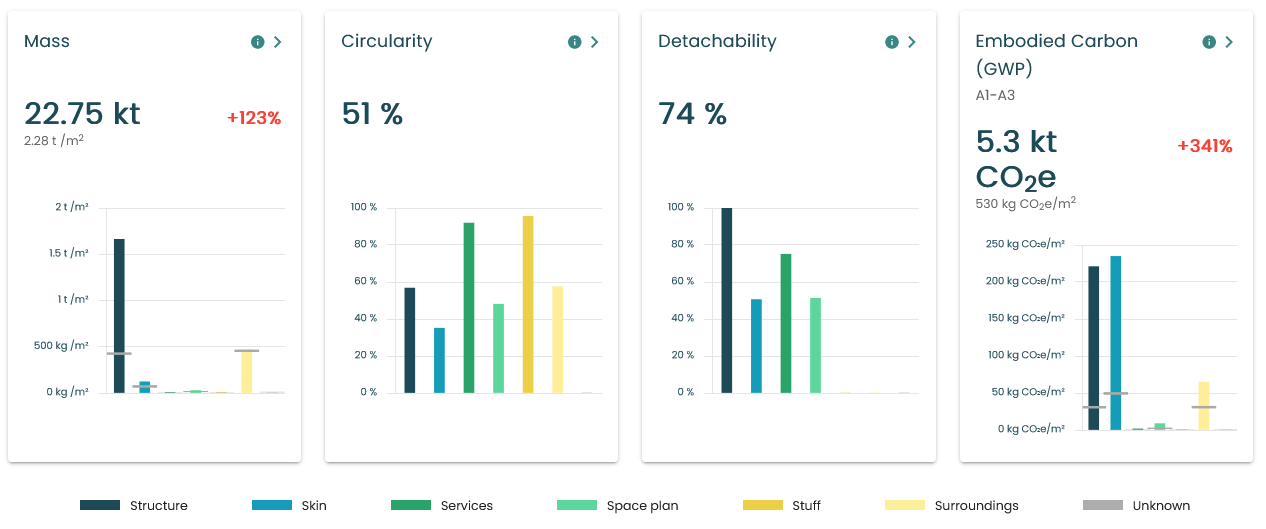
As one of the first Belgian companies, we have incorporated Madaster to create building passports for our projects. By registering building materials on the platform, we can automatically create a unique building passport for each building.
This passport shows comprehensive information about the materials and products used, their impact on circularity and the environment, and the potential residual value they hold.
The (future) owner can use the passport to evaluate which materials could be reused at the End-Of-Life stage of the building.
With this transparent tool, we can evaluate the sustainability and suitability of certain materials and assess their impact on the building.
Our goal is to evaluate the impact of our new projects either with a Life Cycle Assessment (LCA) and/ or a building passport which is due at the end of a project.
CSRD: