
Digital Construction
We see digital construction as a key driver for innovation, enabling more efficient work and helping us fulfill our mission of becoming the fastest builder.
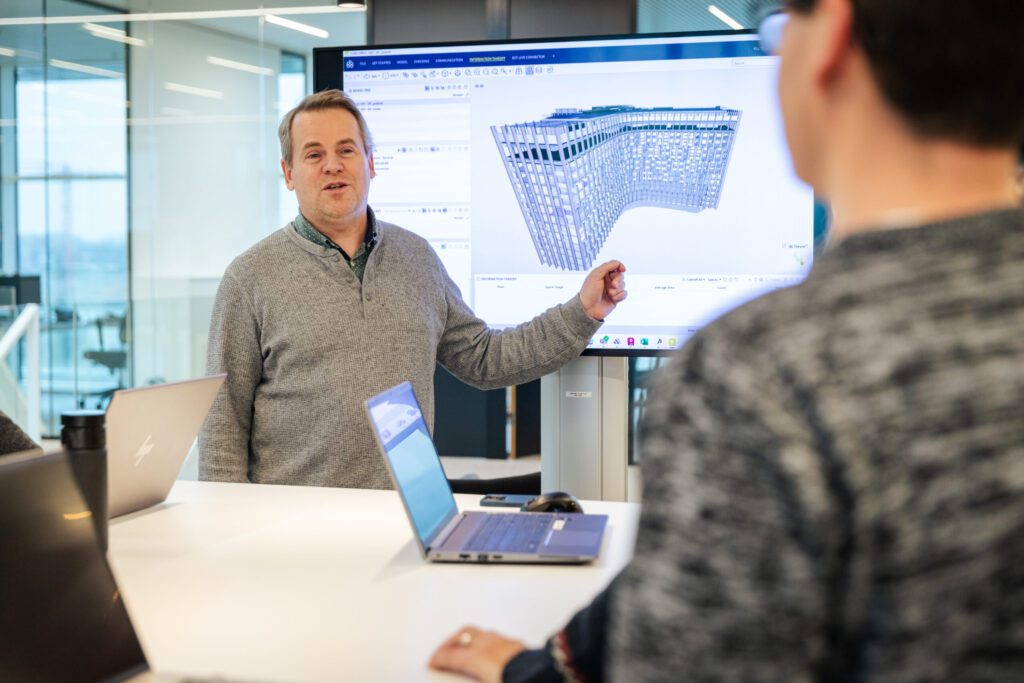
Single source of truth: document management platform
Data is the foundation of modern construction. The question is how to ensure all information is stored centrally and controlled by the right people at the right time.
We work with Dalux, following the international ISO 19650 standard.
Combined with our internally developed company standard, we generate structured (meta)data in the form of project documents. All information is live and centrally available to the full project team.
This gives everyone access to validated data on site, and always the most recent version, which directly reduces failure costs.
Digital and smart site control
Quality control and site optimisation at Cordeel happen digitally, through Dalux.
At fixed intervals, we conduct site walkthroughs with cameras on the helmet, after which every project partner can view and assess the footage.
We can also cross-reference 360° photos and 360° SiteWalks against the BIM model, making remote site inspections possible.
At handover, we deliver a digital dossier that locks in the correlation between the 3D BIM model and the as-built situation.
BIM as a database across all project phases
BIM is virtual construction.
Every element is created once and begins its lifecycle from that point. For this to work across tender, design, execution, maintenance, and management, the underlying methodology has to be solid from the start.
We follow national and BeNeLux standards, including the Basis ILS guidelines (DigiGO / Buildwise) and the NLBE-SfB classification.
These are all embedded in our Cordeel BIM company standard, which applies to both our own BIM teams across the group and our external partners.
We work according to the BuildingSmart approach: an OpenBIM mindset, independent of any specific software.
The BIM model can be used to create life cycle analyses with the software of One Click LCA that we use. This provides us with clear insights on how we can reduce the embodied carbon footprint of our projects.
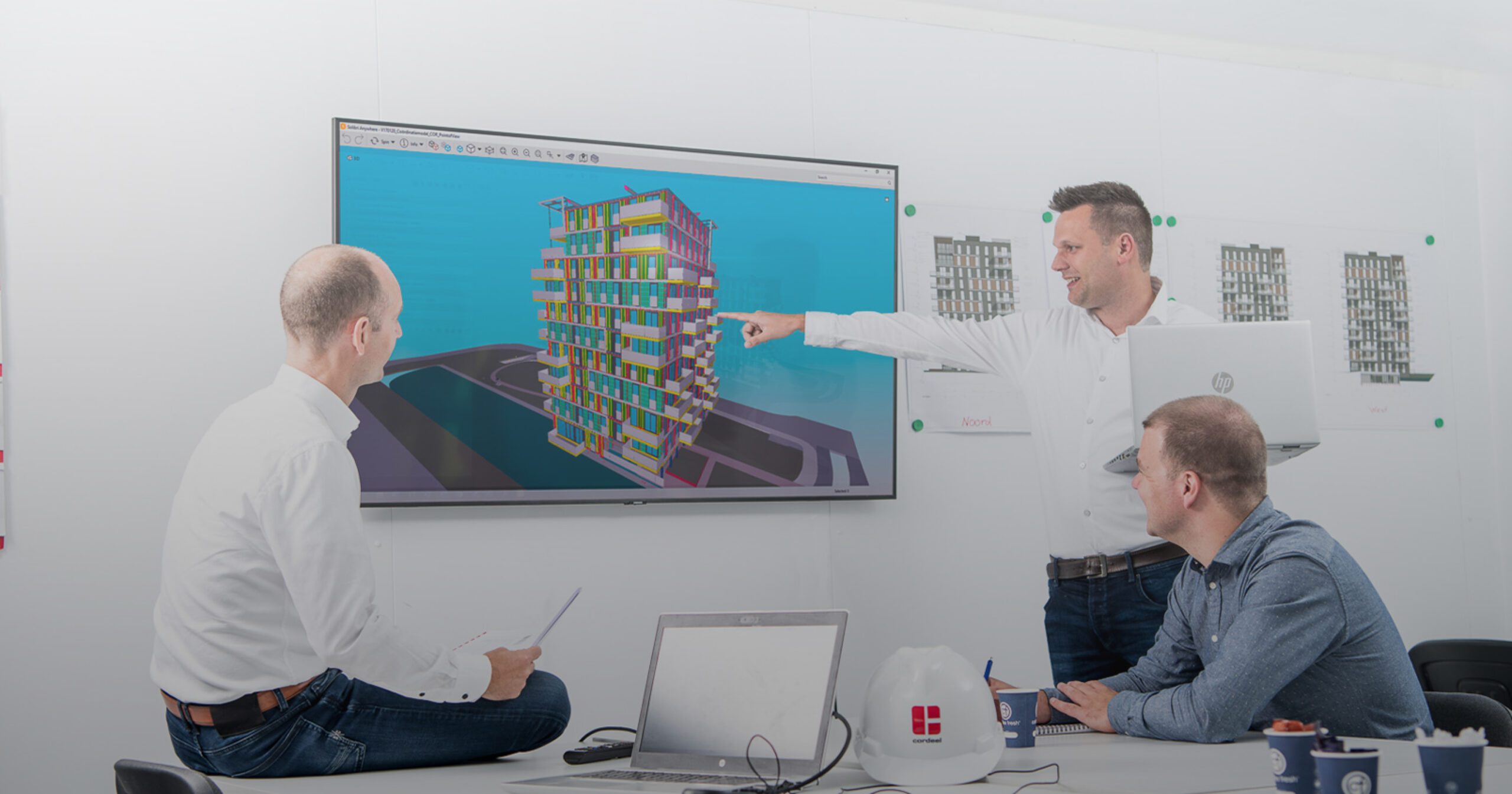
4D simulation: the new way to plan
4D virtual planning has replaced traditional work preparation for us.
Take a 3D BIM model and play it like a film showing the full construction sequence.
To get there, you need both standardised BIM models and a BIM-linked schedule. Together, these allow us to develop scenarios and optimise both site setup and project execution.
AI as a working tool
We work best with standardised data and clear project files. In the tender phase, that is not always what we get.
Large projects generate large volumes of data, and finding the right information quickly matters.
Through Dalux, we search project documents with increasing precision. Combined with CoPilot and a locally specific tendering tool, we can rapidly identify project requirements and client wishes to build the most effective project proposal.
AI also gives us an additional layer of document validation, checking both correctness and content.
Additional digital construction initiatives
Precast request tool
For efficient coordination of prefabricated elements, we developed a precast request tool that replaces Excel sheets, emails, and phone calls.
Site managers and project leaders can directly view the planning and delivery schedule for C-concrete elements on their project, check the status of each element, see whether a delivery is on its way, and schedule deliveries at the element level.
Augmented reality
On several construction sites, we use Trimble’s AR technology to bring the BIM model into the physical space.
Using a tablet, we project the model onto walls or ceilings to verify the placement of pipes or identify where concrete needs to be poured. We also use it to visualise what the finished building will look like, and to check for errors by overlaying the BIM model on the actual site layout.