Nature-positive by 2050

Nature-positive by 2050
At Cordeel, we’ve defined a bold ambition statement consisting of three pillars:
- Making our planet better
- Making a TCO-based approach the norm
- Empowering our people to make all of this happen
As a construction company, we want to make sure we leave room for future generations and that we lead the way towards a future where buildings become carbon sinks and have a positive impact on their environment and surrounding communities.
In line with that ambition, we’ve set the goal to become nature-positive by 2050.
CSRD:
What does nature-positive mean?
“Nature positive” is a global goal to halt and reverse nature loss by 2030, with the aim of achieving full recovery by 2050.
It means that species and ecosystems are being restored and regenerated rather than continuing to decline — with measurable increases in the health, abundance, diversity and resilience of nature.
This ambition was formally adopted in the mission of the Kunming-Montreal Global Biodiversity Framework (GBF) in December 2022, effectively becoming nature’s equivalent of the Paris Agreement for climate.
For businesses, contributing to nature positive means going beyond simply reducing harm: the collective impacts from regenerative and restorative actions must outweigh those from ongoing negative impacts, following a hierarchy of avoid, minimise, restore and compensate to create “no net loss”.

How will we achieve this goal?
Nature is all-encompassing. So when we make investments in scaling circular or bio-based materials or to decarbonise our buildings, products or processes, we’re also investing in minimizing our impacts on nature.
We are already doing a lot, but we also acknowledge a lot still needs to happen. We are currently devising a solid nature strategy and roadmap to turn our ambitious goal of becoming nature-positive by 2050 into reality.
To build our strategy and to make sure we fully align with TNFD (Taskforce on Nature-related Disclosures) we are using the LEAP (Locate, Evaluate, Assess, Prepare) and Act-D frameworks.
Step 1 is to map our impact and step two is to mitigate that impact. To do so, we’re closely following the mitigation hierarchy as described below.
The limitation of this model, however, is that it merely focuses on mitigating negative impacts and net gain contributions (e.g. supporting a nature restoration project). It doesn’t really take into account that a company can also have solutions that have a positive impact on nature, like us. That’s why, we made a small adaptation to the classical model by adding ‘positive impact solutions’ on top of the break-even line.
In our case, these positive impact solutions (e.g. soil remediation, bio-based materials) will help us and our customers to minimize our nature and climate impact, no matter whether it’s inside or outside of our value-chain.
More details on our nature strategy will be published in our next report, but in this chapter (and the one on circularity and climate), we already share the steps we’re taking.
CSRD:

What we currently do
Avoidance
Preventing negative impacts on nature altogether is the first and most important step in the hierarchy. In our core markets — Belgium and the Netherlands, which together represent approximately 95% of our revenue — strict environmental permitting legislation already prohibits many of the most harmful impacts on nature. This provides a strong baseline, though we recognise that regulatory compliance is a floor, not a ceiling.
Minimise
Where impacts cannot be fully avoided, we work to reduce them as much as possible.
A significant share of this effort comes through our focus on renovation and reuse, which already accounts for 14.8% of total group revenue — avoiding the full resource and land-use footprint of new construction.
We are also actively expanding our use of timber-based construction methods, including CLT, timber frame systems and our Sinqer concept, which carry a fundamentally lower nature and carbon impact than conventional alternatives.
On our construction sites, we are rolling out battery-powered equipment and site batteries to reduce emissions and pollution.
Our green concrete performs 33% below market standard in carbon intensity, with a successful pilot already reaching -65%.
And through C-fire, we have developed PFAS-free and biodegradable fire suppression solutions, eliminating a significant source of persistent chemical pollution.
Restore
Beyond minimising our own footprint, we are investing in actively restoring nature.
Through our C-living subsidiary, we are delivering meaningful restoration projects: the Ambiorix depot zone in Aalst involves 3.5 hectares of desealing and habitat restoration, with a further 15 hectares of quality nature development planned in Aalst.
Our energy hills — currently under construction in Temse and recently started in Zutendaal — incorporate dedicated biodiversity plans as an integral part of the design.
Looking ahead, we are developing materials that can actively sequester carbon and support nature, including hemp insulation as a carbon sink.
Contribute
Going further, we are investing in nature restoration that goes beyond our own operational footprint. In 2025, we will deliver a 2-hectare nature restoration project in Mechelen, with detailed habitat and planting plans currently being developed.
A second nature restoration project is planned in Estonia, extending our contribution beyond Belgium. These projects represent our commitment to actively contributing to nature recovery, not merely managing our own impact.
Positive Impact Solutions
Finally, Cordeel offers a range of services to external clients that generate meaningful nature and environmental benefits beyond our own value chain. We have supported the planting of approximately 620 hectares of hemp in Vlaams-Brabant, a crop that improves soil health and sequesters carbon.
Our soil remediation activities — currently running across 10 test projects, including greenhouse trials with C-ground and C-biotech — restore degraded land for future productive or ecological use.
Through our energy transition services, including C-battery and grid congestion solutions, we help clients reduce their environmental footprint at a systemic level.
These positive impact solutions are delivered as services to third parties and are therefore additional to — not a substitute for — managing our own impacts and dependencies.
CSRD:
Biodiversity of our energy hill in Temse
E4-3
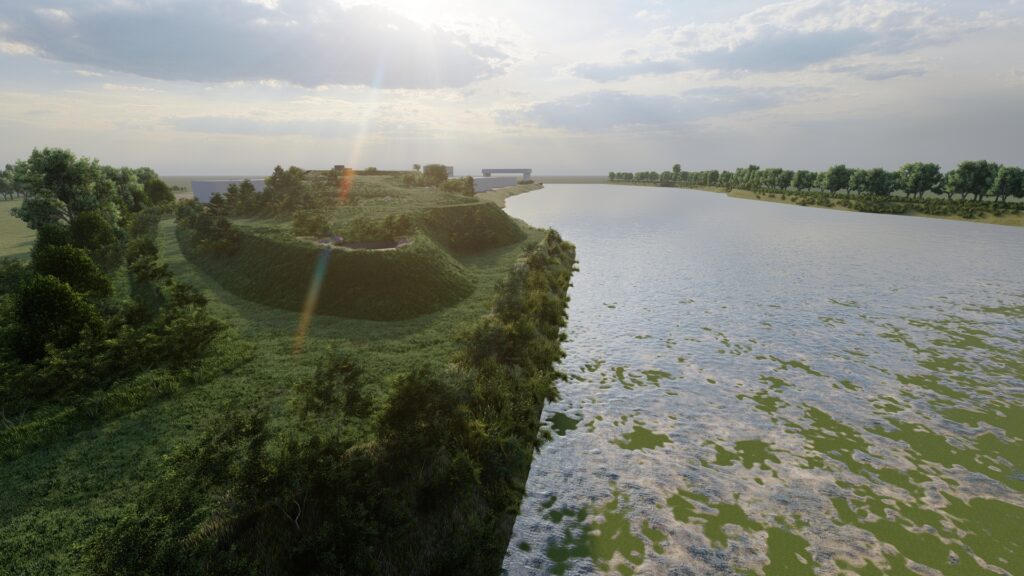
Currently, we’re building the first energy hill as a pilot case in Temse on the location of our headquarter.
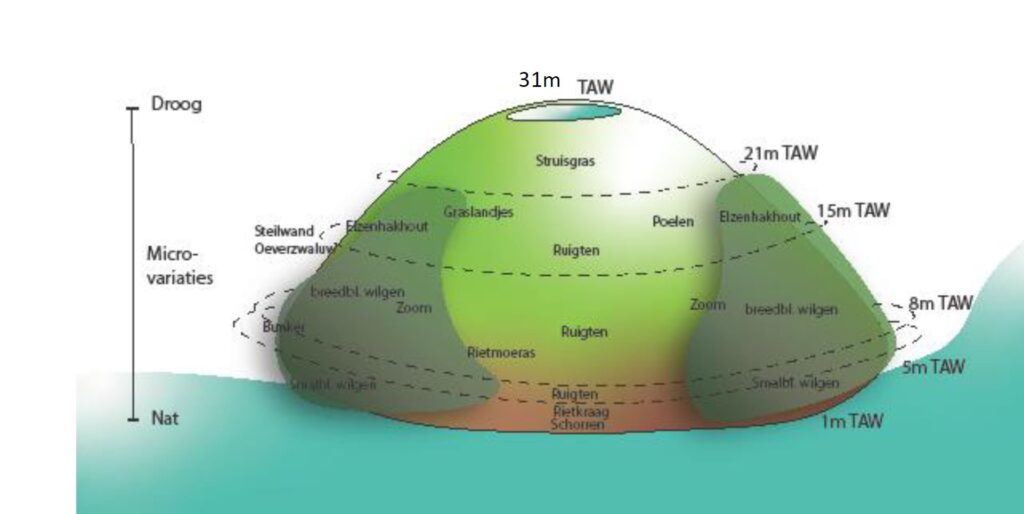
We are constructing a green hill with an altitude of 21 metres, with a water basin placed on top of that hill. The interconnected basins – on top of the hill and at the bottom – form a closed circuit.
Excessive renewable energy or imbalances on the electricity grid, are used to pump up water and store it in the basin on top of the hill as potential energy. This energy can be converted into hydroelectricity as needed.
The final design of each hill is adapted to fit in with the local fauna and flora, creating an integrated ecological habitat that blends in perfectly with its surroundings.
The area is located in a Key Biodiversity Area and in a Natura 2000 area.
We underwent in-depth studies on the possible impact of the energy hill, how we can mitigate these impacts and actually improve biodiversity.
In collaboration with a ecologist we got an overview of the wildlife living and breeding in the area. These comprise quails, bluethroats, sand martin and several bats.
The ecologist created a biological design of the types of plants and habitats that should be located on the hill.
The area used to be a dumpsite of the former shipyard “Boelwerf” which is why we remediated the polluted grounds before the start of the works.
Thanks to these efforts the Agency of Nature and Forest (“Agentschap voor Natuur en Bos”) concluded that building the hill in the way we explained will improve the biodiversity.

Contribute
In 2025, we invested €50,000 in the Muysenhuys nature restoration project, an initiative by Natuurpunt and Natuurpark Rivierenland working to create natural climate buffers and enhance biodiversity in and around Mechelen.
This contribution supports the purchase of 2 hectares of nature area and forms part of the broader LIFE Wetlands4Cities programme, which targets 350 hectares of restored wetlands by 2027, including 17.5 hectares of new nature around Mechelen.
This investment is aimed at actively contributing to the restoration of local biodiversity in the regions where we operate.
E4-3
